Articulated lorry, rigid truck or box van?
There are three vehicle types, selected according to the load and available access.
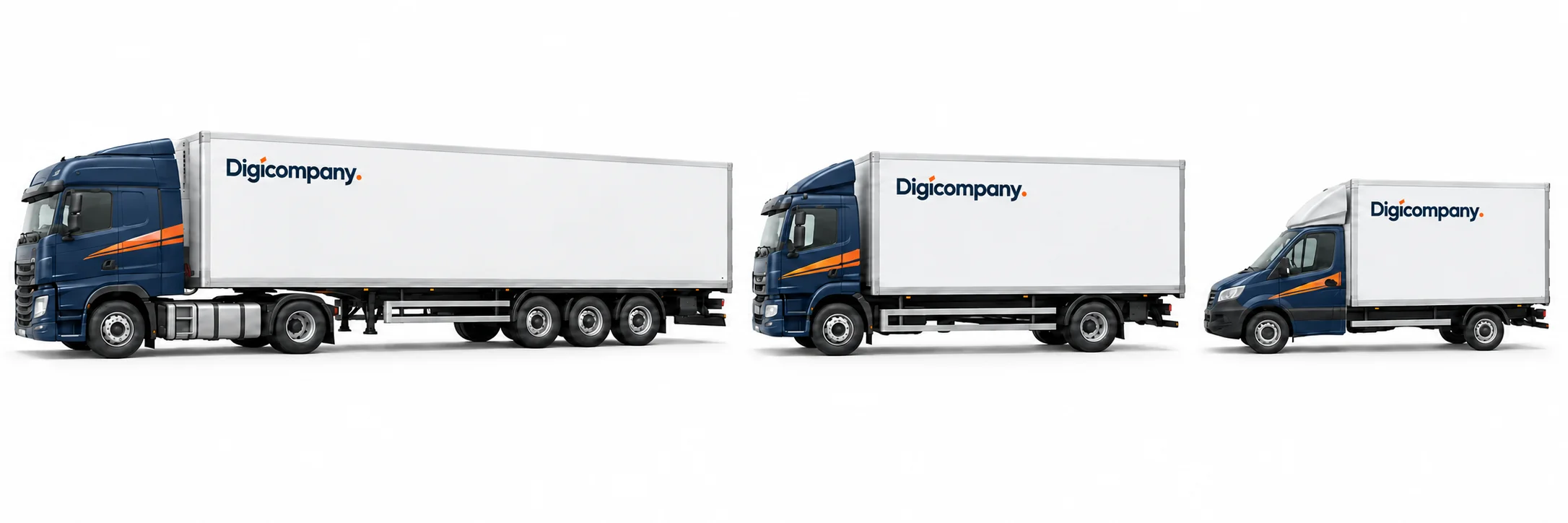
Articulated lorryRigid truckBox van
Articulated lorry. A tractor unit coupled to a semi-trailer. Used for full loads and substantial volumes.
Rigid truck. A truck with its cab and cargo body on the same chassis. Suitable when a shorter vehicle than an articulated lorry is needed.
Box van. A commercial vehicle cab with an enclosed box body mounted behind it. Used for smaller loads and narrower access.
Illustrations are indicative. Dimensions, payload and equipment are checked for each transport.
Road freight exclusively for businesses
DigiCompany works exclusively with businesses: manufacturers, distributors, logistics operators and service companies moving goods regularly. We are not an individual-parcel courier and do not provide removals.
In Rome and the surrounding province, we know industrial and commercial areas such as Tiburtina, Prenestina, Fiumicino, Pomezia and Anagnina. We also consider access restrictions, including restricted traffic zones, opening hours and narrow roads, when preparing the quote to avoid surprises on loading day.
You have one point of contact from planning to delivery. Where needed, we connect transport with storage and goods handling at our partner warehouses.
We do not transport:
- dangerous ADR goods;
- temperature-controlled goods;
- special waste;
- abnormal loads requiring exceptional transport.
Full truckloads (FTL)
With a full truckload (FTL), an entire vehicle is dedicated to your goods: no sharing with other customers or intermediate transfers. Fewer handling operations can reduce transit time and make goods easier to monitor.
FTL is suited to:
- high volumes or recurring flows;
- transfers between warehouses, factories and hubs;
- reducing handling operations and the risk of damage.
Typical examples include regular connections between a warehouse in the Rome area and hubs in northern Italy (Milan, Verona) or Europe (Lyon, Munich), with the vehicle and timing confirmed in the quote for each route.
Palletised goods
We transport standard EUR pallets and non-standard pallets carrying industrial goods, semi-finished products, packaging and exhibition materials. We deliver to:
- distribution depots;
- shopping centres;
- trade fairs;
- construction sites with standard access.
Tell us whether pallets are stackable: this affects the space required on the vehicle.
Bulky loads
We handle large-volume goods within the height, length and mass limits of the Italian Highway Code. Abnormal loads exceeding those limits and requiring special authorisations are outside our service.
Linehaul 365 days a year
Linehaul consists of recurring, scheduled routes between:
- regional and national hubs;
- central and local warehouses;
- distribution platforms and sorting centres.
It operates 365 days a year, with routes and frequencies agreed by contract. Together with the customer, we define the calendar, time windows and loading slots to plan vehicles and shifts and avoid unnecessary downtime and storage.
Examples include:
- overnight connections between platforms around Rome and other regions;
- fixed weekly routes towards European borders.
Origins and destinations
- Rome and the surrounding province: collections and deliveries between business premises, warehouses and shops.
- Italy: collections from suppliers and factories, with delivery in Rome or other regions.
- Europe: road deliveries across Europe, with the vehicle and timing checked in the quote for each route.
- Islands and ferry routes (Sicily, Sardinia and smaller islands): feasibility and timing are assessed individually in the quote, without standard rates or transit times.
How it works: from quote to proof of delivery
1. Request a quote
We need:
- Origin and destination: for example, a factory in Pomezia to a hub in Verona.
- Goods type: industrial components, packaging, promotional materials or semi-finished goods.
- Dimensions and weight of each package or pallet and the entire load.
- Number of pallets or packages and stackability.
- Dates or time windows for loading and unloading.
- Available loading equipment: loading bay, ramp, forklift or requirement for a tail lift.
- Access restrictions: restricted traffic zones, narrow roads, height or weight limits.
2. Vehicle selection and planning
Using those details, we choose an articulated lorry, rigid truck or box van and check:
- payload and occupied volume;
- access at loading and unloading locations;
- site opening hours;
- any special equipment, such as a tail lift, side access or a tarpaulin body for top loading.
The vehicle, indicative timing and feasibility are confirmed in the quote.
3. Loading, transport and delivery
The vehicle arrives within the agreed time window. Goods are loaded and secured following safe handling practices. Full loads travel directly, without intermediate transfers, unless otherwise agreed.
Unloading follows the agreed arrangement: at a loading bay, in the yard, with the recipient's forklift operator or the goods handling we organise. We provide proof of delivery afterwards. We do not offer real-time tracking.
What determines the transport price
There is no fixed price list: each quote is calculated for the specific shipment. These factors affect it.
Route and distance. Distance, tolls and travel through congested areas such as the GRA or restricted traffic zones. For example:
- Rome–northern Italy routes have planning considerations linked to their expected transit time;
- southern destinations or islands may require a ferry;
- European routes involve greater distances and border crossings.
Volume, weight and goods type. Non-stackable pallets and bulky goods occupy more space and may require a larger vehicle. The number of journeys also matters when flows are spread over several days.
Loading and unloading. Availability of loading bays and forklift operators, tail lifts or special equipment, and access restrictions on times, weight or height.
Frequency. With regular flows, such as several weekly journeys to a hub, we can agree:
- a departure calendar;
- preferred loading slots;
- integration with storage and goods handling.
Planned flows help make the solution more efficient.
Who we work with
- Industrial businesses and manufacturers: semi-finished and finished products from factories around Rome to customers and hubs in Italy and across Europe, using dedicated articulated lorries or rigid trucks.
- Logistics operators, distributors and wholesalers: linehaul between platforms and regional depots, and large pallet volumes between central and local warehouses.
- Service businesses with warehouses in Rome: promotional materials, exhibition equipment, appliances and technical supplies for branches and shops. Alternatively, collections from Italian suppliers, consolidation in Rome and full-load international dispatch, with the vehicle and timing confirmed in the quote.
Frequently asked questions about freight transport
Do you handle individual parcels or express deliveries?
No. We transport full loads and palletised goods for businesses. We do not handle individual parcels, express deliveries or small courier volumes.
Do you transport ADR or temperature-controlled goods?
No. We only transport non-hazardous goods that do not require a cold chain.
Do you offer online shipment tracking?
No, there is no real-time tracking. We provide proof of delivery after transport.
Do you provide office or home removals?
No. We only transport goods for businesses. Removals require a specialist company.
Do you ship to and from islands?
Yes, following an individual assessment. The quote specifies feasibility, indicative timing and operating arrangements.
How far in advance should I request transport?
As early as possible, particularly for international full loads and complex routes. Quotes are prepared promptly, but meeting loading windows depends on vehicle availability and complete information. Linehaul is planned when the contract is agreed.
Request a transport quote
In your request, include:
- origin and destination, with the country and full address for international routes;
- goods type, dimensions and total weight;
- pallet or package quantities and stackability;
- planned loading and unloading dates;
- loading and unloading arrangements and access restrictions;
- any assistance needed with loading or unloading.
Photos of the load and access points can help assess packaging, dimensions and manoeuvring space, but do not replace measurements.
Request a transport quote
Related services